Cockroaches are not just insects. They are tiny survival experts with six legs, two antennae, and the confidence of someone who pays rent in your kitchen.
You spray them. They run.
You hit them. They disappear.
You clean the kitchen. They return at midnight like they own the gas stove.
So the big question is: why are cockroaches so hard to kill? The answer is not one magical superpower. Cockroaches survive because they combine speed, flexible bodies, fast breeding, chemical resistance, smart hiding behaviour, and an unbelievable talent for living in places where most creatures would immediately resign.
Let’s break it down with science, logic, and a little respect for the most unwanted roommate on Earth.
Cockroaches Are Built Like Survival Engineers
Cockroaches have existed in some form for hundreds of millions of years. That does not mean the cockroach in your kitchen personally met a dinosaur, but its ancestors clearly attended a long-term survival workshop.
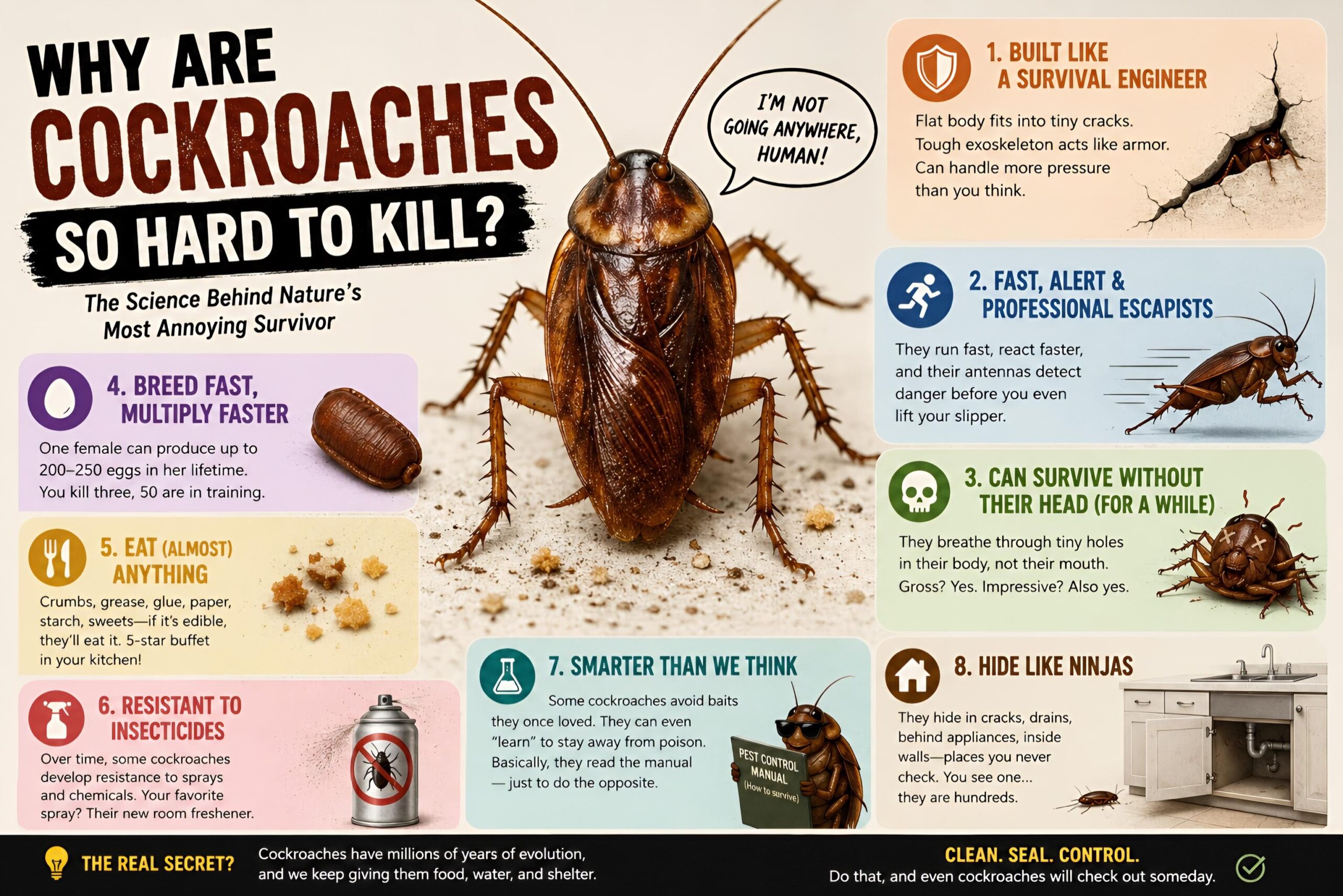
Their flat bodies help them squeeze into cracks, drains, cupboards, wall gaps, pipe openings, and tiny spaces behind appliances. That is why you often see one cockroach and then suddenly lose it. It did not vanish like a magician. It just used a gap you did not even know existed.
This is one major reason why cockroaches are so hard to kill. They do not need a large hiding place. A narrow crack can become a luxury apartment if it has warmth, moisture, and food crumbs.
The U.S. Environmental Protection Agency notes that cockroaches are common indoor pests and that their shed skin and waste can contribute to asthma problems, especially in sensitive environments like schools.
They Run Fast, React Fast, and Panic Professionally
A cockroach does not calmly evaluate danger. It reacts fast.
Its long antennae work like motion detectors. They sense air movement, vibration, smell, and touch. The moment you move your slipper, the cockroach often knows before your brain fully commits to the attack.
Their legs are designed for quick movement. Their low, flat body also helps them escape under furniture and appliances.
This is why killing a cockroach with a slipper feels personal. You are not fighting an insect. You are fighting a tiny emergency-response system with legs.
Cockroaches Can Survive Without Their Head – But Not Forever
One of the strangest facts about cockroaches is that they can survive for some time without their head. This sounds like horror movie material, but there is real biology behind it.
Cockroaches do not breathe through the mouth like humans. They breathe through small openings called spiracles located on the sides of the body. Their nervous system also has nerve clusters spread across the body. So even without a head, some body functions can continue for a short period.
Scientific American explains that a headless cockroach can live for days or even weeks under certain conditions, though it eventually dies because it cannot drink water or eat properly.
So yes, this is one reason why cockroaches are so hard to kill, but let us not exaggerate. A headless cockroach is not immortal. It is just extremely committed.
Their Exoskeleton Works Like Natural Armour
Cockroaches have an exoskeleton, which means their support structure sits outside the body. This outer covering helps protect them from physical pressure and rough environments.
When you try to crush a cockroach lightly, it may survive because its body can tolerate compression better than many other insects. A weak slap may only scare it.
That is why half-hearted attacks often fail. The cockroach gets a warning, a workout, and a dramatic escape story for the family.
However, this does not mean they are impossible to crush. It means their body structure gives them a better chance of surviving poor aim and low pressure.
They Breed Fast, So One Cockroach Can Become a Problem
Another major reason why cockroaches are so hard to kill is reproduction.
Cockroaches do not wait politely for your pest-control schedule. German cockroaches, one of the most common indoor species, reproduce quickly. North Carolina State Extension notes that female German cockroaches can produce multiple egg cases, with a total of roughly 200–250 eggs in their lifetime.
This matters because killing visible adults may not solve the problem. Eggs and young nymphs may remain hidden in cracks, behind refrigerators, under sinks, or inside cabinets.
So when people say, “I killed three, but more came,” they are not imagining things. They probably removed the visible members of a much larger family business.
Cockroaches Eat Almost Anything
Cockroaches are not food critics. They can feed on crumbs, grease, starch, sweets, garbage, cardboard glue, food residue, and organic waste. In homes, they do not need a full meal. A few crumbs near the toaster or oil stains near the stove can support them.
This flexible diet makes them difficult to control. You may think your kitchen looks clean, but cockroaches can survive on what humans ignore.
This is why pest control starts with sanitation. If you remove food, water, and hiding places, you make life harder for them. If you only spray but leave crumbs and moisture, you are basically running a cockroach guest house with chemical fragrance.
They Can Develop Resistance to Insecticides
Cockroaches, especially German cockroaches, can develop resistance to insecticides. A Purdue University study found that German cockroach populations can show rapid resistance changes, including cross-resistance, where resistance to one insecticide may reduce the impact of another.
The original Scientific Reports study also found that single-insecticide approaches can fail when resistance already exists in the population.
This helps explain why cockroaches are so hard to kill with the same spray again and again. If a population survives repeated exposure, the tougher individuals may reproduce. Over time, you may end up with cockroaches that treat your favourite spray like room freshener.
That does not mean all sprays are useless. It means random spraying without strategy can make the problem harder.
Some Cockroaches Even Learn to Avoid Baits
As if chemical resistance was not enough, some German cockroaches have also shown behavioural resistance.
Researchers have studied glucose aversion in German cockroaches. In simple words, some cockroaches evolved to avoid glucose-containing bait because glucose triggered a bitter response instead of a sweet one.
Imagine making poison candy, and the cockroach says, “No thanks, I am watching my sugar.”
This is another reason why cockroaches are so hard to kill. They do not only survive physically. Some populations also change behaviour in response to human control methods.
At this point, it almost feels like they read pest-control manuals just to do the opposite.
They Hide During the Day and Work the Night Shift
Cockroaches usually prefer darkness. If you see one in daylight, it may mean overcrowding, disturbance, or a larger hidden infestation.
They often hide near warmth, moisture, and food. Common places include:
- Behind refrigerators
- Under sinks
- Inside drains
- Behind gas stoves
- In wall cracks
- Around garbage bins
- Inside cardboard boxes
This behaviour makes them difficult to target. You may spray the open floor, while the real colony relaxes behind the cabinet, silently judging your technique.
Why One Spray Often Fails
Many people make the same mistake. They see one cockroach and spray it directly. The cockroach dies, and the person feels victorious.
But the colony may remain untouched.
Sprays often affect only exposed cockroaches. They may not reach eggs, hidden nymphs, or cockroaches deep inside cracks. Some sprays can also scatter cockroaches into new hiding spots.
That is why experts often recommend Integrated Pest Management, or IPM. The EPA describes IPM as a practical approach that combines knowledge of pest life cycles, environmental conditions, monitoring, prevention, and control methods instead of relying only on pesticides.
In short: do not just attack the cockroach. Attack the lifestyle.
The Smart Way to Control Cockroaches
To control cockroaches properly, you need a system.
First, remove food sources. Clean crumbs, grease, food spills, and garbage areas. Store food in sealed containers. Do not leave pet food outside overnight.
Second, reduce water access. Fix leaking taps, dry wet sinks, and check under-sink moisture. Cockroaches love water more than they love your fear.
Third, block entry and hiding points. Seal cracks, gaps near pipes, and openings around cabinets.
Fourth, use targeted bait and traps. Baits work better when placed near cockroach activity zones, not randomly in the middle of the room like decoration pieces.
Fifth, avoid overusing one chemical. Repeated use of the same insecticide may increase resistance pressure in some populations.
Are Cockroaches Dangerous or Just Disgusting?
Cockroaches are not usually aggressive toward humans. They are not tiny vampires. They will not chase you for revenge because you killed their cousin.
But they can still affect health.
Cockroach allergens can trigger allergies and asthma symptoms in some people. Research reviews have linked cockroach allergen exposure with sensitization and asthma-related health effects, especially in indoor environments.
They can also move through dirty areas and then walk over food surfaces. This does not mean every cockroach instantly causes disease, but it does mean you should not ignore an infestation.
A cockroach in the kitchen is not just embarrassing. It is a hygiene signal with antennae.
So, Why Are Cockroaches So Hard to Kill?
The honest answer is simple: cockroaches survive because they have many small advantages working together.
They hide well.
They move fast.
They breed quickly.
They eat almost anything.
They can survive harsh conditions.
Some populations resist insecticides.
Some even avoid bait ingredients.
That combination makes them one of the most successful household pests on Earth.
So the next time someone asks, why are cockroaches so hard to kill, the answer is not “because they are magical.” It is because evolution gave them a survival toolkit, and human homes accidentally give them food, water, warmth, and hiding places.
Basically, we built the hotel. They checked in without booking.
The Cockroach Party: Why They Always Come Back
Sometimes cockroaches do not behave like insects. They behave like a fully organised political party.
You remove one member from the kitchen, and five more appear near the sink by evening. One hides behind the gas stove, another controls the drain area, and the senior leader sits safely behind the fridge.
This is what I jokingly call the Cockroach Janata Party — a secret household alliance with only one agenda: survival.
Of course, this is humour, not biology. But the joke works because cockroaches really do live in groups, hide in colonies, and return again and again if food, water, and shelter remain available.
So when people search for cockroach party or even cockroach janata party, they are probably thinking of the same funny truth: cockroaches never arrive alone. They come with family, backup, and full confidence.
That is why killing one cockroach does not solve the problem. You need to clean food crumbs, dry wet areas, seal cracks, and target the hiding places. Otherwise, the Cockroach Janata Party will hold its next meeting under your kitchen sink.
Cockroaches are hard to kill, but they are not unbeatable.
The trick is to stop treating them like single insects and start treating them like a system. Killing one cockroach may feel satisfying, but removing food, water, hiding spots, and breeding areas works better in the long run.
Use science, not panic. Use cleanliness, sealing, monitoring, and targeted control.
And remember: a cockroach may survive your slipper once, but it cannot survive a well-managed home forever.
That is the real answer to why cockroaches are so hard to kill.
For similar articles visit https://infopillstv.com